ROI Governance for Finance Technology in 2026: How CFOs Decide What to Scale or Stop
ROI governance for finance technology has become a core CFO responsibility in 2026 as organizations increase spending on AI, automation, ERP modernization, analytics, and planning platforms. The challenge is no longer whether finance technology can create value, but whether leaders can prove which investments are scalable, which need redesign, and which should be stopped before they consume more budget.
What Is ROI Governance for Finance Technology?
ROI governance is the structured process CFOs use to evaluate whether finance technology investments are delivering measurable business outcomes. It combines financial discipline, operating metrics, adoption evidence, risk controls, and executive decision gates so technology decisions are based on value rather than hype.
In finance, ROI governance applies to tools such as AI agents, close automation, reconciliation platforms, FP&A systems, reporting dashboards, workflow automation, data platforms, and ERP upgrades. A strong governance model helps CFOs compare expected benefits with real outcomes, including cost savings, productivity, forecast quality, control strength, user adoption, and decision speed.
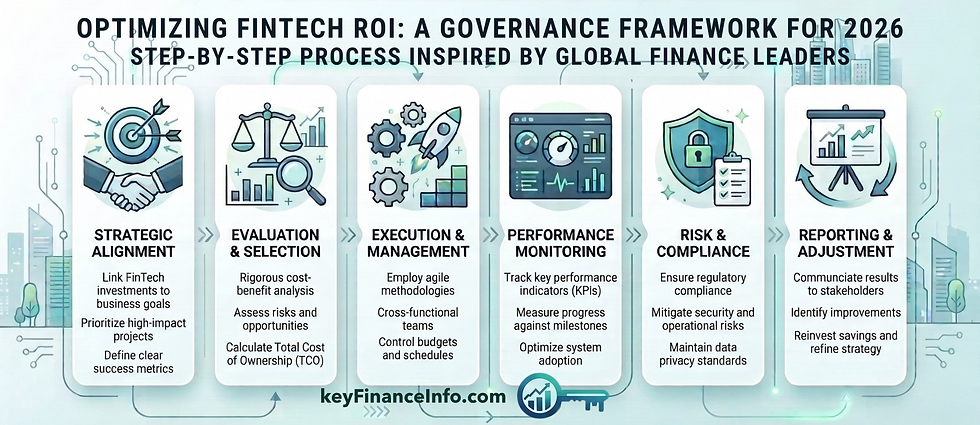
Why CFOs Need Stronger ROI Governance in 2026
Finance leaders are under pressure to show measurable returns from AI and automation while also managing governance, cyber risk, data quality, and accountability. Without clear ROI governance, organizations may scale tools that look impressive in pilots but fail to improve real workflows, controls, or financial performance.
· Creates investment discipline by linking every finance technology project to measurable outcomes.
· Improves scaling decisions by separating proven use cases from attractive but underperforming pilots.
· Strengthens accountability by assigning owners for adoption, controls, costs, benefits, and risk.
· Reduces hidden technology waste by identifying duplicate tools, low usage, weak adoption, and unclear value.
· Protects trust and control by requiring auditability, data governance, cybersecurity alignment, and human oversight.
ROI Governance Criteria for Finance Technology
Governance Criterion | What CFOs Should Measure | Scale or Stop Signal |
Business value | Cost reduction, margin impact, cash flow improvement, forecast accuracy, or faster decisions | Scale when value is measurable and repeatable; stop when benefits remain vague |
User adoption | Active users, workflow completion, usage frequency, training completion, and process dependency | Scale when users rely on the tool; stop when usage stays shallow or forced |
Process integration | Connection to close, planning, reporting, treasury, procurement, billing, or controls workflows | Scale when embedded in core work; stop when it remains an isolated pilot |
Risk and control readiness | Audit trail, access controls, data lineage, cybersecurity review, segregation of duties, and human oversight | Scale when controls are reliable; stop when risk ownership is unclear |
Total cost of ownership | License costs, usage fees, integration effort, support needs, change management, and maintenance | Scale when economics improve with use; stop when costs rise faster than value |
How CFOs Decide What to Scale or Stop
CFOs should begin by defining the value hypothesis before the technology is funded. This means agreeing on the business problem, expected financial impact, adoption target, control requirements, cost boundaries, and review timeline before a pilot or rollout begins.
The decision to scale should be based on evidence that the technology performs in real operating conditions, not only in demonstrations or controlled pilots. If the tool fails to improve outcomes, cannot be governed, lacks adoption, or depends on unreliable data, CFOs should redesign the use case, pause investment, or stop the initiative entirely.
Finance Technology Scale-or-Stop Decision Checklist
Decision Area | Key Question | CFO Decision | |
Strategic fit | Does the technology support a priority finance or enterprise objective? | Scale if aligned; stop if it solves a low-value problem | |
Measured ROI | Are benefits visible in financial, operational, or decision-quality metrics? | Scale if evidence is credible; pause if results are anecdotal | |
Adoption and behavior change | Are teams using the tool as part of normal work? | Scale if adoption is sustained; redesign if users work around it | |
Control environment | Can finance, audit, compliance, and IT explain, test, and monitor the tool? | Scale if control-ready; stop if accountability is unclear | |
Data readiness | Is the underlying data complete, trusted, timely, and well-owned? | Scale if data is reliable; fix the foundation before expansion | |
Economic sustainability | Do license, usage, integration, and support costs remain justified at scale? | Scale if unit economics improve; stop if costs compound without value |
ROI governance for finance technology gives CFOs a practical way to turn innovation into accountable value creation. In 2026, the strongest finance leaders are not simply funding more AI, automation, and analytics; they are building the decision discipline to scale what works and stop what does not.

Finance technology succeeds when it improves real work, strengthens controls, supports better decisions, and delivers measurable outcomes. Done well, ROI governance helps CFOs protect budgets, reduce technology waste, and build a finance function that is both innovative and financially disciplined.
FAQ about ROI Governance for Finance Technology in 2026
What is ROI governance for finance technology?
ROI governance is the process CFOs use to evaluate whether finance technology investments are delivering measurable value, adoption, control strength, and business outcomes.
Why is ROI governance important in 2026?
It is important because AI, automation, and finance technology spending are increasing while CFOs face pressure to prove value, manage risk, and avoid waste.
What metrics should CFOs use to measure finance technology ROI?
CFOs should measure cost savings, productivity, adoption, cycle time, forecast accuracy, control quality, cash impact, risk reduction, and decision speed.
When should CFOs stop a finance technology initiative?
CFOs should stop an initiative when value is unclear, adoption is weak, costs exceed benefits, data is unreliable, or controls cannot support safe scaling.
How can CFOs improve scale-or-stop decisions?
CFOs can improve decisions by setting clear value hypotheses, reviewing evidence regularly, assigning owners, testing controls, and comparing actual outcomes against expected benefits.
ROI Governance for Finance Technology in 2026: How CFOs Decide What to Scale or Stop


Comments